
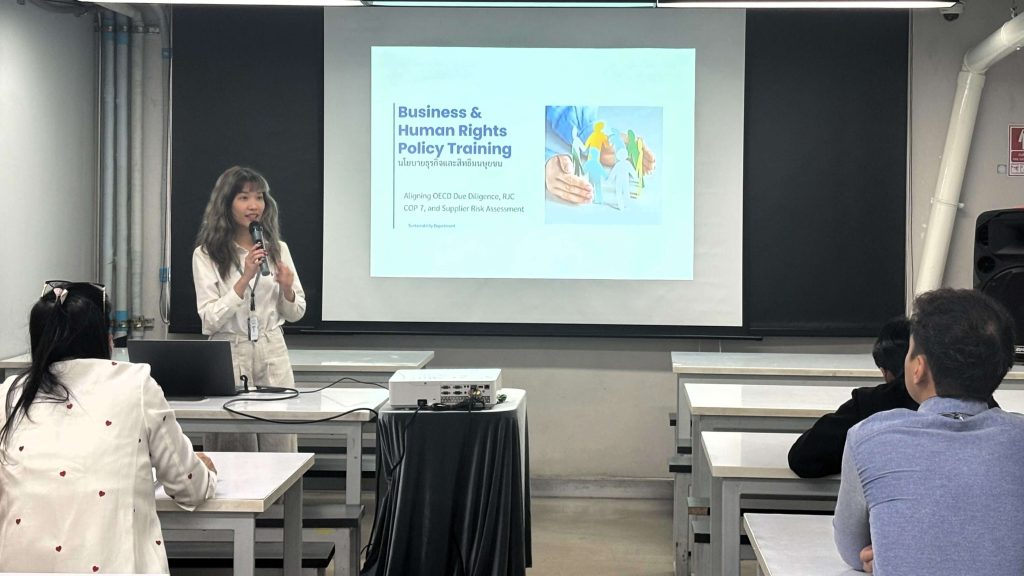
As part of Artinian Co., Ltd.’s ongoing work toward Responsible Jewellery Council (RJC) certification, we conducted a Business & Human Rights Policy Training for employees across relevant functions. The session was led by Nichakarn Muangsanit, Sustainability Assistant, with support from Ananya Tritipthumrongchok, HR Manager.

The training aimed to strengthen understanding of international human rights expectations, supply-chain responsibility, and individual roles in preventing risks. These efforts support compliance with global standards, reduce operational exposure, and reinforce trust with customers and business partners.
Why Business & Human Rights Matter
The session explained how human rights are directly linked to business risk, governance, and reputation. Participants learned that issues such as labor rights violations, lack of transparency, or unethical sourcing can become direct legal and commercial risks. Aligning with international expectations helps Artinian operate responsibly across markets such as the EU and the United States, while maintaining consistent ethical standards.
OECD Due Diligence Framework in Practice
Participants were guided through the OECD 5-Step Due Diligence Framework, which Artinian applies to its supply chain. The framework covers establishing internal systems, identifying risks, managing those risks, conducting audits, and reporting transparently. The training showed how these steps move from policy into daily operational practice, especially when reviewing suppliers and sourcing materials.
Understanding RJC COP 7 Requirements
The training included a focused overview of RJC Code of Practices (COP 7), which integrates OECD due diligence principles into the jewelry industry. Attention was given to human rights due diligence related to labor conditions, sourcing from high-risk or conflict-affected areas, and respect for local communities. This understanding supports Artinian’s preparation for RJC assessment and long-term compliance.
Applying Risk Awareness and Gatekeeper Roles
A key part of the session focused on practical application. Teams reviewed supplier risk indicators such as country risk, product origin, and supplier transparency. Real-life scenarios were discussed to help participants recognize warning signs, including unusual pricing, lack of disclosure, or non-standard logistics routes. Employees were reminded of their role as gatekeepers, helping ensure that only responsible and ethical partners enter Artinian’s supply chain.
What Participants Learned
- How to apply the OECD 5-step due diligence process when reviewing suppliers
- How to identify red flags related to sourcing, transparency, and human rights risks
- How individual roles contribute to early risk detection and responsible decision-making
By strengthening internal awareness and practical knowledge, Artinian Co., Ltd. continues to embed responsible business conduct into everyday operations. These actions form a key part of our structured and ongoing journey toward RJC certification and long-term supply-chain integrity.
Copyright © Artinian Co., Ltd 2025. All Rights Reserved.
Disclaimer: All or part of the content, articulations, and images contained in this communication are proprietary to Artinian Co., Ltd. and or related entities and hence may only be reproduced or shared with prior written permission.


